

Work to craft the perfect fit for artefacts taking shape
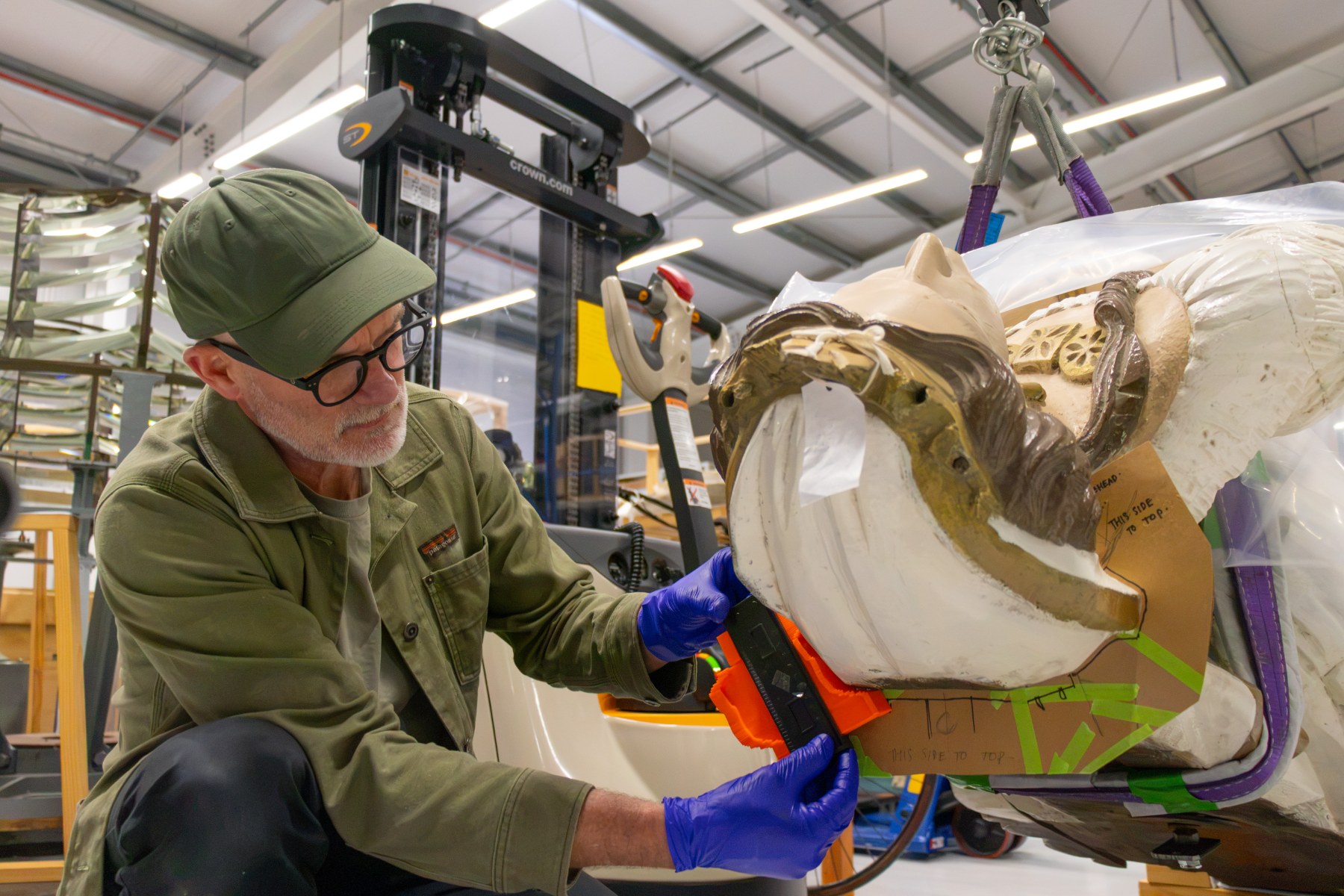
Object Support director, Stephen Brookbanks, with the figurehead from the barque England’s Glory. Collection of Te Kupeka Tiaki Taoka Southern Regional Collections Trust, 83.3395
The painstaking process to design and develop bespoke mounts for the artefacts on display at Southland’s new regional museum has begun.
Mount making was a specialised museum practice that involved crafting custom structures – including plinths, brackets, cradles and stands – to safely hold artefacts and taoka.
Te Unua Museum of Southland Director Eloise Wallace said physical work to create the mounts for the long-term exhibition would begin in October.
“The mounts will play a vital role in preserving the objects set to be included in exhibitions at Te Unua, while also ensuring manuhiri can experience our region’s treasures up close when the museum opens its doors,” she said.
“The process to conceptualise bespoke mounts, and then actually bring them to life, is incredibly specialised and intricate mahi. When you are working with precious artefacts and taoka collected across generations, a deep level of understanding for how to handle and display those items in a way that will preserve them, and enhance storytelling and visitor understanding, for years to come is integral.”
Well-designed mounts helped visitors understand the deeper meaning of the stories behind each artefact, and it was critical items were mounted in an ethically and culturally-appropriate way, Wallace said.
“With mounts, if they’re done right, they become invisible to the visitor – but they are bespoke, creative, and functional designs in their own right that have an incredibly important job to do,” she said.
Custom exhibition development firm Object Support had been tasked with creating about 150 mounts needed for the long-term exhibition at Te Unua Museum of Southland, in partnership with the museum team.
The experience team at Te Unua, meanwhile, and local subcontractors would undertake the mount-making work required for artefacts to be displayed in the museum’s temporary galleries.
Object Support director Stephen Brookbanks had worked in the industry for more than 30 years, after a start at Auckland Museum Tāmaki Paenga Hira.
“The first concern is assessing how stable an object is, and getting a sense of details like the weights and the fragility of items. Everything has to start with the safety of the object – you can’t do anything in terms of fabricating a mount that is going to cause damage, or the object is going to be better off left alone.”
Among the items in need of a custom mount for display at Te Unua would be the figurehead from the barque England’s Glory, which was shipwrecked off the coast of Bluff in 1881 and gave its name to the coastal walking path the Glory Track.
The figurehead was estimated to weigh around 100 kilograms.
“That end of things is definitely more challenging. For the mount making of an object like that, you’re veering into engineering. The machine we use to lift that is for lifting car engines, which gives you a sense of the scale needed in terms of its structural supports for display in a museum,” Brookbanks said.
At the other end of the scale, a mount for a set of bagpipes was also needed.
The bagpipes had belonged to prominent high-country pioneer, Scottish-born Donald Angus Cameron, who founded and leased the historic Nokomai Station (originally known as Glenfalloch) in northern Southland.
“You have to get it right. If the mount for the figurehead fails, it could wreck the case the item is in, it could wreck the object itself, and it could potentially hurt somebody. Whereas for items like the bagpipes, if you don’t get the mount right, they’ll just droop and look a bit sad,” Brookbanks said.
“That’s kind of the fun of it, to be honest. Some of the items you’re working with are really complex and heavy, but at the other end of the spectrum you’re working at jewellery scale, with delicate jewellers’ tools. That’s what makes it interesting: you get to cover that full spectrum.”
The process to design and build a mount was completely bespoke, with materials and techniques used dependant on the nature of the artefact itself. Larger artefacts could be crafted from a steel flat bar, while smaller mounts were fabricated in steel wire treated with a specialised plastic coating, Brookbanks said.
“You just try and come up with the simplest solution for each. The idea is that at the end of the day, the public comes in and has no idea of the work that has really led up to everything being displayed – to them, it all looks great.”
Physical construction of Te Unua was almost completed, with the museum set to open to the public in 2027.
